
Into the Bramblejade, Part 2
The party must brave the Bramblejade and reach Verdantguard tower. But are they ready for the dangers and secrets that await within?


Mutated cultist encounter for parties of 4th-level or higher, with stat blocks for use in D&D 5e.
The moon hangs low in the night sky. It shines against faraway darkness, a divine pearl offering its solace to all who travel or wander. To most, it is a mundane celestial fixture too distant to offer a second thought. But to those who need it, whose hearts spark an indescribable yearning for the moon’s pale light, it is the very gate of heaven. Some nights, it seems close enough to touch, if they were only to reach out. And reach out they did.
Some miles from town, a hilltop cathedral had been restored and converted into an abbey, occupied by scholarly monks studying celestial patterns. These monks maintained a comfortable relationship with the nearby settlement, often visiting for supplies and accepting new pilgrims and students who heard of their studies. They even held a rapport with the town’s guard, who had initially treated them with considerable skepticism. But this friendship waned as the the monks’ visits grew rarer and those who did appear developed behavioral oddities. They would speak in wide-eyed vagaries of what they had observed in the skies above, the meanings of celestial motions, and the truths that were revealed to them in the cycle of the moon. Even their clothing changed, simple robes being given thick hoods and cloths drawn across their faces. And then their visits stopped.
Within the abbey, the monks’ studies had borne fruit. Their time in quiet solitude, watching the moon and bathing in its light, had fomented an obsession. The researchers began to experience whispers and visions that they believed came from the moon itself, offering them new insights into the secrets hidden behind reality and promising a way to transcend mortal existence. They fervently pursued this path of inquiry, doing anything necessary to delve deeper and gain greater understanding. This culminated in a series of rituals that would allow them direct communion with their moonlight patron.
Were one able to ask the monks the result of this communion, they would describe it as little more than a fleeting glance. Each ritual granted the barest, teasing glimpse of truth that left them with a yearning so deep that they did not notice how they were being changed, body and mind. By the time they learned enough to understand, it was already too late. The entity they contacted was not what they had thought. It was no benevolent patron guiding its followers, but an alien mind that the monks had simply chanced to overhear. But in their communions, they drew its attention, and each glimpse of its truth twisted the abbey’s inhabitants further into crazed, malformed facsimiles of this lunar presence.
Though the villagers know nothing of their recent fate, the monks’ strangeness and sudden disappearance spread a pervasive anxiety through the town. This unease forced the leader of the guard, Ava Corwin, to overstep the usual bounds of the settlements’ relationship. She sent Giles Normand, a lifelong friend and veteran soldier, for what should have been a simple check of the abbey. He is yet to return.
Ava must now prepare for the worst. The abbey must be investigated, but the remaining guard is a lax assemblage of young men with little experience beyond hunting, and who are no match for anything that could overpower Giles. She needs more capable fighters and those who might be able to ascertain what exactly happened to the monks. With them, she might be able to stop whatever has occurred within the abbey before the influence of the moon can spread any further.
(LN female human bandit captain)
A guardswoman, many years past her prime, wears a black overcoat atop the scuffed chain mail of her uniform. She pays you a courteous smile, contrasted by the dark, tired eyes that inspect you from beneath the wide brim of her hat.

The town guard is headed by Ava Corwin, an ex-soldier who earned the role due to being one of only two people with any worthwhile combat experience. She is assisted by the other of the two, her lifelong friend Giles Normand, who has acted as her right-hand for many years. Together, the pair has been enough to handle the town’s infrequent disputes, rarely having to put their old skills to use or rely on the rest of the guard, which comprises almost entirely of young local men pushed into the role by their parents or lured in by their own inflated concept of a guard’s role.
Ava is a dutiful woman who keeps few close friends, but holds undying loyalty to those she has accepted into her circle. As such, she is cautious and discerning in conversation and rarely gives away personal details. This goes doubly for stories from before she came to the town, Giles being the only person to ever know the truth of Ava’s past life and the skills she still maintains. Naturally, she was suspicious of the nearby monks upon their arrival, though their polite visits and Giles’s placations eventually won out over her reservations, a turn that Ava now sees as a failure. She is adamant to right this mistake, doing everything she can to control her personal concern for Giles as she negotiates with a new group to investigate the abbey.
Arranging an investigation. Ava has exercised extreme caution since Giles’ disappearance. She has instructed the townsfolk to not approach the abbey and has made only fleeting visits herself, never met with anything more than a voice speaking through the cathedral doors. She knows that the scholars are still inside and has noted what she can of their behavior and schedules. All she needs now is additional manpower.
Ava does not hesitate to approach any adventurers in town. She makes quick conversation about their current business before leading into the topic of the abbey, which the group would likely have already heard of in whispers from the townsfolk.
Ava explains the situation in detail and answers any questions the adventurers have about the town, abbey, and recent events. Naturally, she offers payment in exchange for their help. Her plan is as follows:
She and the adventuring party will head for the abbey in the dead of night. Though some of the researchers may be awake, they should be stargazing on the hill behind the building, and many others should be sleeping. The darkness should similarly prevent the group from being seen approaching across the openness of the hill. Fortunately, they do not have to make it all the way to the entrance, as Ava knows of an old hidden access tunnel that opens into the abbey’s library, a remnant of when the area was far more dangerous. With it, they can breach the abbey to find Giles and ascertain just what the monks have been up to, hopefully with minimal resistance.
The cathedral seems even larger on the inside. Enormous doors open into a hall of weathered stone, columns rising up from cobbled paving like fortress towers. The room is directed towards a stage at its far end, a raised stone platform for speakers to lead sermons from, which is overlooked by a trio of statues depicting moments of celestial intervention. Four rows of pews are set in attendance, their wood aged and broken, while the aisle between them is illuminated by a beam of cold moonlight that shines through the stained-glass window above the main entrance.
The cathedral is an old building that was once popular amongst the townsfolk, but that fell into disrepair as religions shifted and waned. Its emptiness, seclusion, and position atop a tall hill made it the perfect site for a sect of monks seeking a place to live, and from which they could study the movements of stars. It was granted to them with only light opposition, and so was converted into a refuge for them and the students who later arrived to join them.
The cathedral, now acting as an abbey for the stargazing scholars, is comprised of three main structures. The largest and oldest is the main hall, an expansive stone building that housed the sermons and other rituals for which it was originally built. To either side of that are the library and dormitory. The latter housed those who would live at the cathedral, its living areas growing more cramped as travelers and researchers have come to join the current inhabitants. The library, as one might guess, was a repository of knowledge. A portion of its texts still remain, dusty shelves holding all manner of books pertaining to religions and their relevant doctrines and studies. This became the natural place for the monks to carry out and chronicle their research, and they have ensured that all of their own recordings, theories, and conclusions have been meticulously added to the bookshelves.
Access tunnel. In ages past, the land that the abbey and neighboring town are situated on was subjected to the attacks of armies, invaders, and roving bandits. The original inhabitants therefore created safety measures to ensure that they could avoid or escape the violence, one of which included a hidden tunnel that connects the abbey’s library to an entrance at the far foot of the hill.
The tunnel’s outside entrance is not hidden, though not many people know of its existence, even the monks being unaware. The tunnel itself is carved through the earth in a mostly straight line and is held by wooden supports. It is 5 feet wide and 7 feet tall, large enough for a Medium-sized creature to move through, or a Large creature to squeeze through, and has no light sources. It ends at a vertical shaft with a ladder that climbs to a trapdoor. This hatch opens into the abbey’s library, its other side being hidden by a rug that covers it.
Monk’s memoirs. The monks have kept written records of everything they have observed since moving into the abbey. These records are easily found on an upper shelf in the library, and contain diagrams and timelines of different constellations and other celestial bodies.
Of more interest is a book left open on a writing desk, a quill and ink bottle still beside it. Inspecting the text reveals it to be a diary of one of the recent converts. A character that spends several minutes skimming the writing learns the following information:
Alongside other inspirations, the monks and their mutations are all designed to fit our ‘Moonlit Cathedral’ battle map, which make for a fitting arena in which to confront the moontouched scion and herald. We also have a series of maps and assets that are perfect for the abbey’s dormitory and library…


Those who inhabited the abbey have been changed by their experience. Whatever god or devil it was whose attention they drew, its influence pierced them to their very souls, twisting them in ways they could not have predicted. Each encounter brought new insights and new changes. But their resulting forms are not the apotheosis they once sought. They have grown in the entity’s image, their bodies evolving and minds lost in the infinite knowledge of the divine, moonlit radiance that they invited into the cathedral.
CR 1/2
The figure turns to you, bedraggled clothing hanging from their body like an old scarecrow. Their skin is greyed and hair grows in matted, sodden patches, draping over their face to hide gnarled teeth and a pair of eyes that shimmer like drops of quicksilver.


None of the abbey’s inhabitants escaped the moon’s influence, though the degree to which it affected them has varied with their exposure to it. Many of them caught only a glimpse, due to being excluded from the rituals, being lucky enough to turn away, or because one simple glance was all that they could muster, their mind quickly breaking under the weight of what they saw.
Those who met this fate are referred to as moontouched dregs, a name that holds twofold derision. Their appearance wastes as the dregs claw at their own clothes and grow bestial fur, while they are simultaneously looked down on by those who have fully embraced the moon, the dregs having gleaned only meager scraps of knowledge from their respective encounters. Yet the name is also an understatement of the danger they present. Though their behavior is influenced, much of their intelligence remains, the dregs still wielding weapons and moving in organized mobs. This intelligence is quickly eclipsed by blind rage once they are injured, however, their newfound violence always aimed towards those who might oppose the moon’s will.
CR 1
A grotesque humanoid wears torn, moistened remnants of a monk’s garb. Its arms have grown far beyond its sleeves with similarly distended hands almost reaching the ground, its silvery skin pulled tight over lithe muscles. Worst of all is the protrusion that has subsumed its head, a tumorous grey bulb large enough to hunch the creature’s spine, with brain-like ridges that pulse, flex, and occasionally blink open to reveal malformed human eyes.

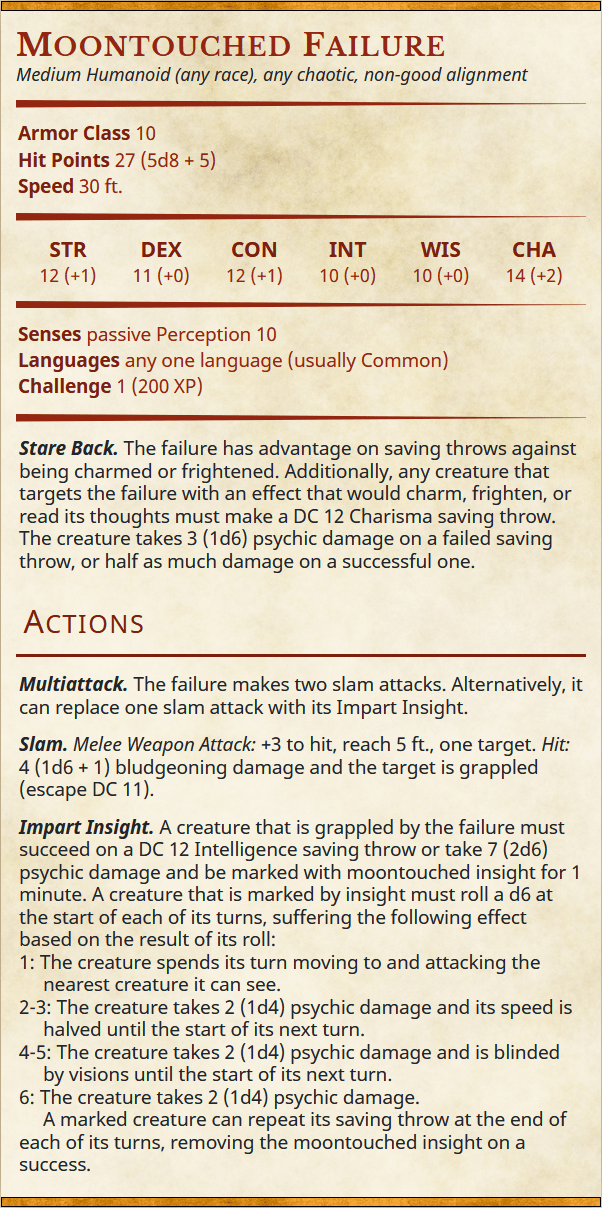
Those who communed longer with the moon entity have experienced far greater alterations. Their bodies and minds have been transformed in the image of their erstwhile idol. But their metamorphosis was neither a clean nor complete process, earning their name by falling short of the perfection they strive for. These monks have been changed into moontouched failures, personifications of their vision that reaches beyond the mortal realm. The monks’ wish to share their insights has only been galvanized in their moontouched minds, which can now force debilitating streams of eldritch knowledge into those unfortunate enough to be caught in a failure’s grasp.
CR 2
The man stands over a foot taller than he should, his arched back hiding the true extent of his malformation. But more than enough is visible to see the wrongness of his shape. His skin is stone grey, with white hair that falls from beneath the brim of his hat and from the openings of his coat, like the pelt of a mange-ridden hound. Elongated claws grip tightly to a crossbow and woodcutter’s axe as he sniffs at the air, a pained snarl drawling from behind misshapen teeth as a pair of empty, silver eyes flick manically in search of prey.


As a retired soldier, second-in-command of the town guard, and friend to the monks, Giles Normand was the obvious choice to check in on the abbey. But what should have been a brief conversation led to Giles being drawn inside the cathedral and exposed to the influence within. He now stalks its halls as a moontouched hunter, ever on guard for other interlopers.
The hunter is a form of moontouched very similar to the dregs, their body twisted with the features of a mangy beast. The difference is in the extent of the changes. The animalistic gifts granted by the moon have found greater purchase within them, giving the hunter keener senses, a sharpened mind, and a body that only grows stronger as it sustains damage. Where the dregs devolve into blind rage, the hunter draws closer to the bestial vision of the moon, its lycanthropy-like abilities enhancing its speed and ferocity. This is made all the more dangerous by their former experience, as moontouched hunters are most often born from soldiers, mercenaries, and adventurers, and retain their martial prowess alongside their new bestial instincts.
CR 3
Cold grey skin clings to the bones of a naked, hairless imitation of a man. The creature is undoubtedly humanoid, but its otherworldly composition is obvious from its stretched, misshapen skeleton, sunken grey eyes, and a lipless mouth that curves in a pained smile. Drapes of skin hang from its back like fins, the organic cloak shifting and flowing as the creature lurches forward, each movement accompanied by a low whine that occasionally rises to an excruciating, tearful shriek.


Only a single person within the abbey was given the truest gift of the moon, its insights in physical form. The abbot, Michael Lahey, was transformed within an unearthly womb that grew at the cathedral’s pulpit. He emerged as a child of moonlight known as the moontouched scion. The scion’s body has been altered from head to toe and bears only a passing resemblance to the man it once was, its identity being traded for physical strength and an appearance that walks a disturbing line between man and monster. Even worse is its mind. Where one might expect the wisdom of alien enlightenment is instead a howling, infantile rage. The scion lashes out violently at any who would separate it from its caretaker, savagely projecting the pain it feels for having been orphaned from its skybound mother.
CR 3
Darkened, torn rags, bandages soaked in old blood, and a shroud of black and silver all hang from an invisible mass, accented by ritualistic beads and other jewelry. The various cloths loop and tie around unknown shapes, giving a suggestion of the torso and numerous limbs of an unseen creature that rouses to movement. Four of these extremities reach out, indistinct hands clasping at enormous blades. Yet despite it and its weapons’ size, the creature moves without effort and makes no sound save for low breaths that drift from beneath the hood.
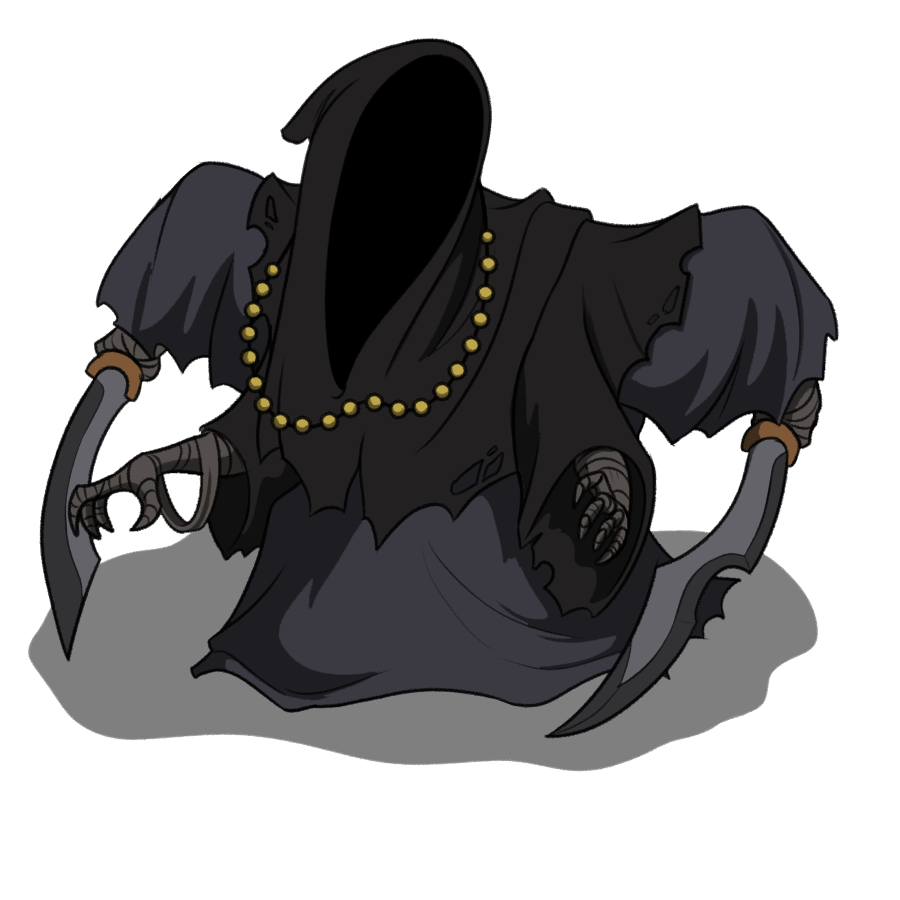

The first to glimpse the moonlight entity was not given a gift, but a task. The unfortunate scholar, known as Oswald, underwent a gruesome, agonizing, and prolonged metamorphosis, their body fading from visibility as it mutated in the darkened basement of the abbey. The resulting creature emerged once the transformation was complete, visible only for the bandages and cloths its fellows had applied in an attempt to ease its pain, which now hung from a monstrously large, distended form. This creature was a moontouched herald, chosen to act as a carer for the scion that was soon birthed at the pulpit. It now continues to protect its ward as the child grows, nursing it within the cathedral and using its invisibility and several weapons taken from cathedral statues to guard the scion from harm.
Balancing the Challenge Rating of the encounter at the abbey should center around two factors: the presence of Ava and the confrontation with the moontouched scion and moontouched herald.
The former is ostensibly simple, as having Ava with them raises the party’s effective CR by 2. And while this is easy on paper, it is important to remember that CR is far from a perfect metric. A party of 3rd-level characters, though mathematically a match for the herald and scion when with Ava, will have individually fewer hit points and lower damage output than the 5th-level characters that a CR 5 encounter expects. As 5th level also tends to be a prominent spike in power for player characters, you may wish to err on the side of caution when balancing the fight with parties that are 4th level or under.
The latter fight acts as the climax of the encounter against its most powerful creatures, and so forms the baseline requirement for building out the combat. Fortunately, it is relatively easy for the herald and scion to be used in isolation from the other creatures. They are the only occupants of the cathedral, while the other monks and Giles inhabit the rest of the abbey, the latter even able to be used as a patrol of the area’s outskirts. This provides an explanation for the party being able to fight the herald and scion without other creatures getting involved, which is made even easier by having the characters face smaller groups of the monks on their path to the cathedral, thinning their numbers before facing what was the Abbot and Oswald.
If you are hoping to lower the CR even further, the option also exists to altogether remove the scion, herald, or both. The story of the scholars being enraptured and changed by the moon still works without the inclusion of the largest creatures, and the climactic fight can be shifted to instead focus on either one of the two, or Giles. The only other adjustment that needs to be made is the removal of the notes mentioning what happened to the Abbot and Oswald.
Conversely, the difficulty of the fight against the herald and scion can also be increased quite easily. The party holds an inherent numbers advantage, particularly with Ava accompanying them, which can be reduced by having Ava be waylaid by another group of monks or by including other moontouched in the cathedral. Similarly, the noise of combat might draw other dregs and failures to the central room, allowing you to have them intermittently join the fight as a means of adjusting the difficulty. This also provides a sense of urgency to the encounter as more of them converge on the cathedral, and prompts the characters to think about more than simply dealing damage to the two main opponents. They can stem the tide of monks by sealing off entrances or creating hazards that they must pass. But be sure to not overuse these waves of dregs, or you risk having the isolated abbey suddenly feel like an infinite monk printer.
Here are some examples of creature groups you can use to achieve different CR values for each group of moontouched within the abbey:
CR 5: 1 moontouched hunter, 2 moontouched failures, 2 moontouched dregs
CR 6: 1 moontouched herald or moontouched scion, 2 moontouched failures, 2 moontouched dregs
CR 8: 1 moontouched herald, 1 moontouched scion, 1 moontouched failure, 2 moontouched dregs
CR 10: 1 moontouched herald, 1 moontouched scion, 1 moontouched hunter, 1 moontouched failure, 2 moontouched dregs
If you enjoy this content and would like to support Troy in creating more, please consider joining the community that makes it all possible. You can receive discounts, early access, and other exclusive bonuses in exchange!

You can also further support our talented token artists by buying them a cup of coffee!

You may also want to be notified when we upload something new. Please come join us on social media, or subscribe to the email newsletter!

About the author
Leave a Comment
Related Posts
The party must brave the Bramblejade and reach Verdantguard tower. But are they ready for the dangers and secrets that await within?

A sea hag has overtaken a hidden pirate grotto and filled it with her undead and monstrous, oceanic minions.

A troop of monkeys steals from the onsen’s customers, taking their treasures to a kami that makes its home in the mountain springs.